

Summer holidays, Christmas, school breaks, airports know these periods will be busy.
Passenger volumes can be forecast, resources planned, and additional capacity prepared in advance.
But some of the most challenging operational peaks are not on the calendar.
They can develop on an ordinary Monday morning when a delayed flight, an early arrival and an existing traffic peak suddenly overlap.
The challenge for airport operations is therefore not only planned for known peak periods. It is anticipating the peaks that develop during the Day of Ops, before passengers experience their impact.
Why Airport Planning Alone Can’t Prevent Operational Peaks
Airport planning depends on flight schedules, passenger forecasts, available capacity, resources and expected processing times.
But on the day of operations, those assumptions continuously change.
Flights arrive earlier or later. Passenger behavior varies. Processing times change. Resources become unavailable. Weather or disruptions elsewhere in the network affect the schedule.
Individually, these changes may be manageable.
The problem starts when they interact.
A delayed flight does not automatically create congestion. Neither does an early arrival. But when several changes bring additional passengers into the same operational window, a normal period can suddenly become a peak.
A Normal Morning Can Become a Peak
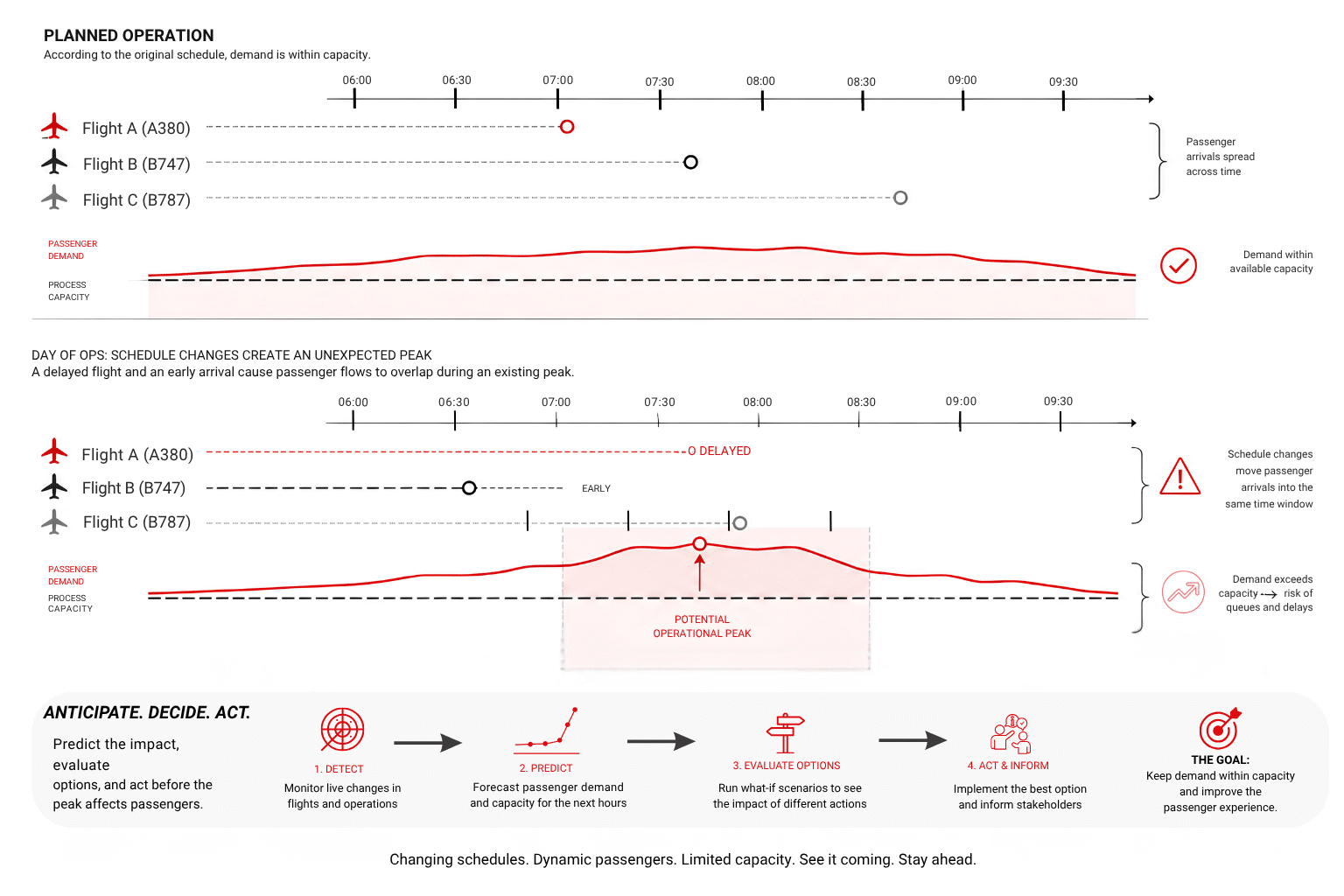
Imagine Monday morning at 07:00.
Then an A380 arrives later than expected, while another large aircraft arrives early. Their passenger flows now overlap with flights already scheduled during the morning peak.
Suddenly, hundreds of additional passengers are moving toward immigration within the same time window.
Capacity that looked sufficient in the original plan is now under pressure.
Queues form. Waiting times increase.
Afterwards, identifying the cause is relatively easy.
The more important question is:
Could operations have seen it coming?
From Knowing About a Delay to Understanding Its Impact
Knowing that a flight is delayed is useful.
Knowing what that delay will do to the operation is much more valuable.
A changing arrival time can affect immigration demand. Departure delays can influence gate occupancy. Connecting passengers can create pressure on transfer processes.
And several relatively small changes can combine into one significant operational bottleneck.
This is why effective airport delay management needs to look beyond individual flights.
Operations need to understand:
- Where will additional demand appear?
- When will it arrive?
- Will available capacity be sufficient?
- Which process could become the next bottleneck?
- How much time is available to respond?
That turns operational information into operational foresight.
From Delay Data to Operational Understanding
A delay code can indicate why a flight is delayed, but understanding its operational relevance requires additional context. The same delay may have very different consequences depending on the affected flight, passenger volumes, available resources, connected processes, and the wider operational situation.
This is where operational reasoning adds another layer. By interpreting delay information together with the surrounding operational context, airports can move beyond identifying a disruption to understanding why it is happening, what it may affect next, and which factors should be considered when deciding how to respond.
Can Airports Predict Operational Peaks Before They Happen?
Airports can anticipate potential operational peaks by combining changing flight schedules with passenger-flow, process and capacity data. This makes it possible to identify where demand may exceed available capacity before congestion becomes visible in the terminal.
By combining changing flight information with passenger-flow, process and capacity data, airports can continuously evaluate how the operation is likely to develop over the next hours.
If several flights shift into the same arrival window, for example, future demand at immigration can be recalculated.
Instead of discovering the problem when the queue is already there, operations can identify the potential capacity constraint earlier.
That creates an important shift:
From seeing what is happening now to understanding what is likely to happen next.
Prediction Is Only Useful If You Can Act on It
Knowing that congestion could develop in 60 minutes is valuable.
But the next question is even more important:
What should we do about it?
Opening additional processing capacity may help. Redirecting passenger flows may be another option. Resources could potentially be reallocated.
But airport processes are interconnected. Improving one area can sometimes create pressure somewhere else.
This is where what-if simulation becomes valuable.
Operations can evaluate different scenarios before taking action:
What happens if we open additional capacity?
What if the delayed flight arrives another 20 minutes later?
What happens downstream if passenger flows are redirected?
The objective is not to predict every disruption perfectly.
It is to give operations enough foresight to make a better decision while there is still time to influence the outcome.
From Reactive to Predictive Airport Operations
Real-time visibility tells airport teams what is happening now.
Predictive operations add another question:
What happens next?
That creates a simple progression:
What was planned? → What is happening? → What is likely to happen? → What can we do about it?
This matters because operational peaks are not limited to summer holidays or other predictable high-traffic periods.
Sometimes the next peak starts with just a few deviations from the plan.
Peak Periods Aren’t Always on the Calendar
Airport operations will never follow the plan perfectly.
The opportunity is to identify deviations early enough to understand their consequences.
Because the next operational peak might not happen during summer, Christmas or a major holiday.
It might begin with one delayed flight and one early arrival on an otherwise ordinary morning.
The question is whether operations discover that peak when the queue forms or before it does.
Anticipate What’s Coming Next
AMORPH.aero helps airports move from operational data to operational understanding. By combining changing operational conditions, predictive simulation, what-if analysis, and operational reasoning, airport teams can better understand emerging disruptions, their potential consequences, and the options available to respond.
What could your operations team do with 30, 60 or 90 minutes of additional foresight?
FAQ
What is airport delay management?
Airport delay management involves identifying and responding to the operational effects of changing flight schedules, passenger demand, resource availability and processing capacity.
How do flight delays create airport congestion?
Flight delays can shift passenger demand into different time windows. When delayed or early flights overlap with existing traffic peaks, demand can exceed available capacity at processes such as immigration, security or baggage reclaim.
How can airports anticipate operational peaks?
Airports can combine live and expected flight information with passenger-flow, process and capacity data to forecast how demand may develop. Predictive simulation can then help identify potential bottlenecks and evaluate possible operational responses.
How can operational reasoning help airports manage flight delays?
Operational reasoning helps interpret delay information in its wider operational context. By considering delay codes alongside flight, passenger, resource and process information, airports can better understand the cause of a disruption, its potential downstream effects and the factors that should be considered when evaluating a response.